Hannah Martin dances full-time as a professional ballerina, runs two YouTube channels, and built an online academy with five courses. She uploads one to two videos a week and hasn't missed a beat. A year ago, she was editing eight hours a day and couldn't find time to see her friends.
What changed was a system, not a schedule hack or a productivity app or some heroic increase in willpower.
Eight Hours of Editing, Zero Hours of Living
Before Hannah built any kind of workflow, she was doing everything herself. Filming, editing, uploading, responding to comments, managing courses, planning content, all squeezed around a full-time ballet career that demands 40+ hours a week of physical performance.
"I've never had time to go out with friends," she told us. "I'm editing eight hours of my day normally."
When you're a solo creator producing long-form YouTube content, editing is the bottleneck that swallows everything. A 15-minute vlog can take four to six hours to cut. A tutorial, longer. Multiply that by two uploads a week and the math stops working fast.
Hannah knew she wanted to take YouTube and her course business more seriously. The content creation itself was manageable because she could vlog a few days of her ballet life or film a 30-minute stretch tutorial before work. The production side, turning raw footage into finished videos, was what consumed every spare hour she had.
An Ankle Injury Forced a Different Question
Then Hannah got badly injured. Surgery on her ankle put her ballet career on pause, and she tried to force her way back, pushed her body harder, but the injury kept getting worse.
Her dad flew in to stay with her. He could see she was in a bad place, physically and mentally, and he said something that reframed everything: "When life gives you lemons, make lemonade."
Hannah was frustrated at first. She thought he was talking about her comeback, and she was already trying everything. But her dad meant something different. The lemons weren't the injury. The lemon was having free time for the first time in her professional life, and she wasn't using it.
That conversation shifted her focus. Instead of pouring all her energy into a recovery that wasn't working, she started building the business she'd been putting off.
Her dad encouraged her to join Ali Abdaal's Part-Time YouTuber Academy. That same weekend, the two of them went out and bought lights, a camera, and the microphones she still uses today. About two grand total. Every purchase felt risky. Her dad had to push her through each one: "Just buy it, because once I leave I know you won't."
She hasn't looked back on a single one.
The Production Bottleneck Cracked Open
The gear was step one. The real shift came when Hannah started thinking about content production as a system rather than a solo effort.
She went on Upwork and started what she calls "auditioning" editors (ballet terminology carrying over naturally). Found people she could work with. But immediately ran into the problem every creator hits when they first try to delegate editing: how do you actually communicate about the work?
"I was thinking, how on earth am I going to communicate with this editor? How does this even work? Are we going to do that all over WhatsApp? Email is so difficult to go back and forth on."
This is where most creator-editor relationships get messy, and it's a pattern we see constantly. Getting an editor is the easy decision. Managing the back-and-forth, sending files, leaving timestamped notes, reviewing cuts, requesting changes, all of that needs a system or it drowns in scattered message threads. It's the same problem engineering teams solved years ago with version control and code review tools. The work isn't hard, but without a central place for it, every handoff generates friction.
Hannah's dad (who at this point deserves some kind of producer credit) sent her a link to Clipflow. She looked at it for about 10 seconds and decided she was in. "I'm quite a decisive person," she says. "Yes, all in or all out."
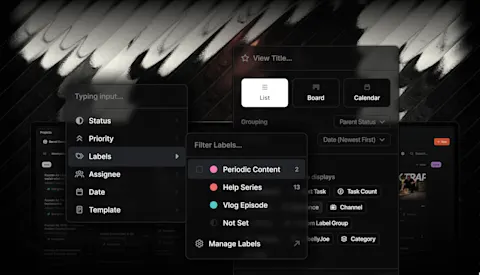
She started using Clipflow to manage the handoff with her editors and the production bottleneck opened up. File sharing, notes, feedback, revisions, all centralized instead of scattered across WhatsApp threads and email chains.
"If I hadn't had Clipflow, I wouldn't have been able to create the amount of content I've been able to turn out in the last six months."
We actually told Hannah before recording that she didn't have to mention Clipflow at all. She brought it up because it was genuinely part of the story.
Two Channels, Two Editors, One System
With editors handling production, Hannah had bandwidth to think strategically about her content. One of the first decisions she made was splitting her YouTube channel into two.
Most advice says consolidate your audience. Hannah went the other direction, and the logic is sound. Her channel had two types of content: day-in-the-life vlogs and workout/stretch tutorials. The audiences barely overlapped. When she uploaded a vlog, the tutorial people weren't interested. When she uploaded a tutorial, the vlog people skipped it. Every upload was disappointing roughly half her subscriber base.
Splitting solved the mismatch. Each channel now serves a specific audience with content they actually want. And the system that makes two channels viable is straightforward:
- Vlogs: Hannah films a few days of her ballet life and sends the footage to her editor Colton about a week and a half before the Tuesday upload. They have a rhythm. When she falls behind it gets messy, but the baseline system keeps things moving.
- Tutorials: She goes into work early one morning, films a 30-minute stretch or workout tutorial, and sends it to her brother (her other editor). One or two tutorials go up per week.
Neither channel requires Hannah to edit. She films, hands off, reviews, and publishes. The creative work stays with her. The production work runs through the system.
Five Courses, Built During Recovery
During her injury recovery, Hannah maintained both YouTube channels and built something new: the Make It Happen Academy, an online platform for dancers and movers that currently includes five courses covering strength, flexibility, mindset, nutrition and body confidence, and injury mentoring.
The mindset course alone is 30 videos long. She created it while working with a nutritionist and wellness coach from New York, with editors in Pakistan and South Africa handling post-production, all coordinated through Clipflow.
"I started going crazy with creation, to be honest."
This is what happens when you remove the production ceiling. When editing consumed eight hours of Hannah's day, creating a 30-video course wasn't realistic. With editors and a centralized workflow in place, she built five courses and kept two YouTube channels running simultaneously.
Now she's developing the marketing side. Building the Make It Happen Academy Instagram page (grew roughly 4,000 followers in about a month by posting three reels a day). Experimenting with paying UGC creators to promote the courses for the first time. Working on licensing music for a ballet course module. Planning and growing, rather than just producing.
Her YouTube channels tick over in the background because the system handles it. When ballet season gets intense and shows take priority, the content doesn't stop.
"Since I've brought on editors and have this system that just flows, suddenly I'm like, how do I have all this extra time? I actually have a life."
Separate the Creative Work From the Production Work
Hannah's situation is specific (professional ballet, niche YouTube, online courses) but the pattern underneath applies to anyone producing content regularly.
The pattern: separate the creative work from the production work, then build a system around the production side.
Creative work is the stuff only you can do. Filming, deciding what to make, your perspective, your expertise, your face on camera. Production work is everything that turns raw creative output into published content: editing, formatting, scheduling, uploading, thumbnail creation.
Most creators treat these as one job. The longer you keep them bundled together, the more the production side eats into the creative side until you're spending eight hours editing and zero hours thinking about what to make next.
Hannah outsourced the production pipeline, not her creative vision, and built a communication layer that lets her manage it without drowning in message threads. The result is two YouTube channels, five courses, and an academy Instagram that's growing, all maintained alongside a professional ballet career.
The tools matter less than the separation. But the tools do matter. Hannah tried WhatsApp and email for editor communication and hit a wall almost immediately, the same way engineering teams hit walls when they try to run code reviews over Slack threads. A centralized system for file sharing, timestamped notes, and revision tracking turned a chaotic process into something that, in her words, "just flows."
If you're producing content regularly and the hours keep expanding, the instinct is usually to produce less or try to edit faster. The better question is probably: which parts of this process actually need to be me, and which parts just need a system?